LEADERS

TOP International LEADERS Calling Market Crashes Years Ahead
Second to None, Anywhere...

'Warned 2000 tech slide; predicted 2008 meltdown in 2007. Forecasted 2020 global economic collapse in 2011, AND NOW- BY 2050 - THE MOTHER OF ALL CRASHES"

Featured post

A #TALE OF TWO CITIES - #ECONOMICS AND #SCIENCE COLLIDE

  SURREAL ECONOMICS OR CONCRETE SCIENCE? ORIGINAL POST It  was the best of times, it was the worst of times, it was the age of wisdom, it wa...

Think, act ,lead

Search This Blog

HUGE SAVINGS ON HOT NEW ITEMS

Tuesday, 7 May 2019

#Collapse Approaches - Do The #Math

"The main lesson for me is that growth is not a “good quantum number,” as physicists will say: it’s not an invariant of our world. Cling to it at your own peril" 

By Tom Murphy

Image result for simple math

Exponential Economist Meets Finite Physicist

Some while back, I found myself sitting next to an accomplished economics professor at a dinner event. Shortly after pleasantries, I said to him, “economic growth cannot continue indefinitely,” just to see where things would go. It was a lively and informative conversation. I was somewhat alarmed by the disconnect between economic theory and physical constraints—not for the first time, but here it was up-close and personal. Though my memory is not keen enough to recount our conversation verbatim, I thought I would at least try to capture the key points and convey the essence of the tennis match—with some entertainment value thrown in.
Cast of characters: Physicist, played by me; Economist, played by an established economics professor from a prestigious institution. Scene: banquet dinner, played in four acts (courses).
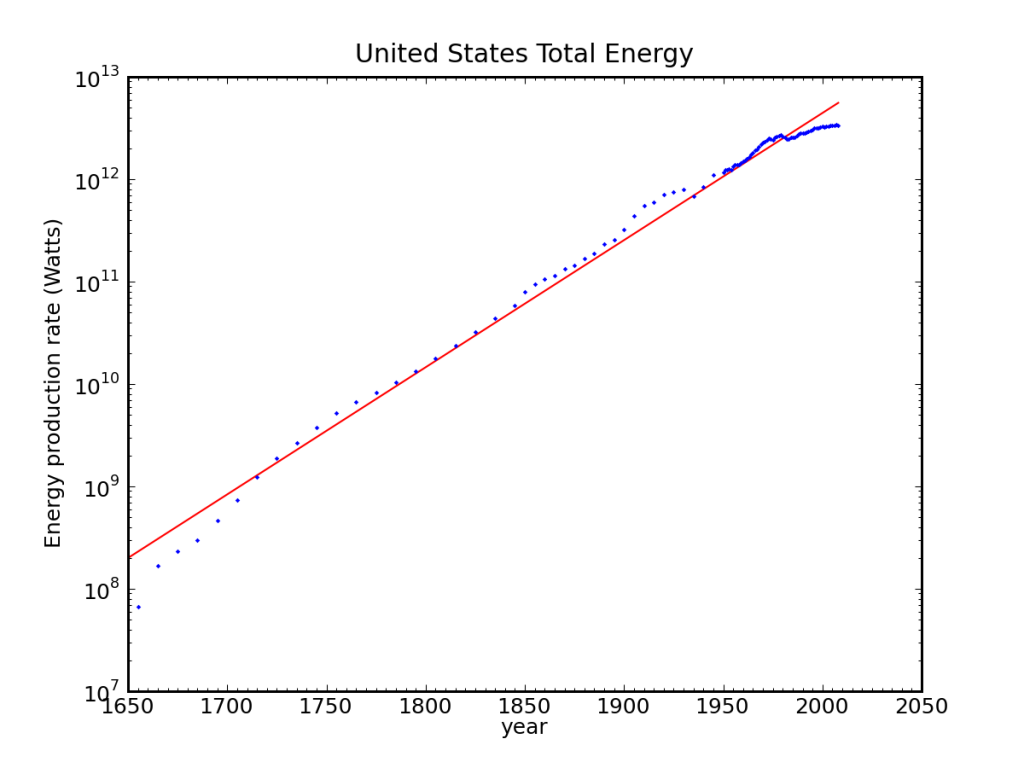
U.S. total energy 1650-present (logarithmic)
Note: because I have a better retention of my own thoughts than those of my conversational companion, this recreation is lopsided to represent my own points/words. So while it may look like a physicist-dominated conversation, this is more an artifact of my own recall capabilities. I also should say that the other people at our table were not paying attention to our conversation, so I don’t know what makes me think this will be interesting to readers if it wasn’t even interesting enough to others at the table! But here goes…

Act One: Bread and Butter

Physicist: Hi, I’m Tom. I’m a physicist.
Economist: Hi Tom, I’m [ahem..cough]. I’m an economist.
Physicist: Hey, that’s great. I’ve been thinking a bit about growth and want to run an idea by you. I claim that economic growth cannot continue indefinitely.
Economist: [chokes on bread crumb] Did I hear you right? Did you say that growth can not continue forever?


LEARN MORE
MIT LIMITS TO GROWTH

Monday, 6 May 2019

Transition From Fossil #Fuels Ushers Dark-Age #Outlook

 "We can’t know exactly what is ahead, but it is clear that moving away from fossil fuels will be far more destructive of our current economy than nearly everyone expects"
 Image result for fossil fuels

 The true feasibility of moving away from fossil fuels

One of the great misconceptions of our time is the belief that we can move away from fossil fuels if we make suitable choices on fuels. In one view, we can make the transition to a low-energy economy powered by wind, water, and solar. In other versions, we might include some other energy sources, such as biofuels or nuclear, but the story is not very different.


The problem is the same regardless of what lower bound a person chooses: our economy is way too dependent on consuming an amount of energy that grows with each added human participant in the economy. This added energy is necessary because each person needs food, transportation, housing, and clothing, all of which are dependent upon energy consumption. The economy operates under the laws of physics, and history shows disturbing outcomes if energy consumption per capita declines.


There are a number of issues:

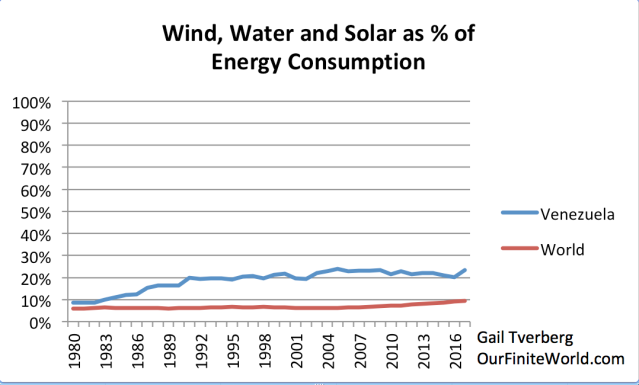
  • The impact of alternative energy sources is smaller than commonly believed.
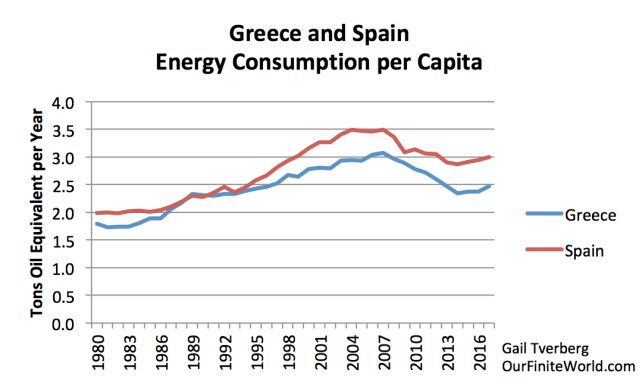
  • When countries have reduced their energy consumption per capita by significant amounts, the results have been very unsatisfactory.
  • Energy consumption plays a bigger role in our lives than most of us imagine.
  • It seems likely that fossil fuels will leave us before we can leave them.
  • The timing of when fossil fuels will leave us seems to depend on when central banks lose their ability to stimulate the economy through lower interest rates.
  • If fossil fuels leave us, the result could be the collapse of financial systems and governments.
  •  
  • Read More
  •  
  •  
LEARN MORE 

NOT AN EASY TRANSITION


Dream, Believe, Inspire